
Sham elections are a familiar feature across much of Asia, where the outward rituals of democracy often endure even as genuine political choice fades. When outcomes are broadly seen as predetermined, participation itself becomes the offering, giving voters a sense of inclusion in a process that holds little real power. Myanmar’s military rulers appear to be banking on that logic as the country proceeds with elections nearly five years after the armed forces overthrew the last elected government in the February 2021 coup.
The voting is taking place against the backdrop of a nationwide civil war and the junta’s limited control over large parts of the country. Even so, the military has pushed forward with an electoral process that allows little space for meaningful competition. Most established political parties and prominent leaders have been sidelined, banned, or silenced, narrowing the field well before ballots were cast. In that vacuum, the military-backed Union Solidarity and Development Party is widely expected to prevail, its rise largely assured long before election day.
A Multiphase Election, With Little Sense of a Campaign
The election is being carried out in three phases. The first round of voting took place on December 28, covering more than 100 townships, including the commercial capital, Yangon. A second phase is scheduled for January 11, with another 100 townships set to vote. A final round is planned for January 25, although details of that stage were announced later.
The initial phase has already concluded, marked by a striking absence of the color, energy, and mass participation that once defined Myanmar’s democratic elections. Familiar political leaders were nowhere to be seen, and early official figures pointed to low voter turnout. State media reported that junta backed parties were leading, reinforcing the widespread perception that the outcome has long been predetermined. Two additional phases remain before the military formally announces the result it is widely expected to deliver.
The junta has insisted that the vote represents a step back toward democratic rule. On paper, 57 political parties are listed on the ballot. In practice, most are seen as linked to or dependent on the military. Only six parties are contesting seats nationwide, while the rest are running in a single state or region. The military backed Union Solidarity and Development Party has fielded the largest slate of candidates and is effectively running unopposed in dozens of constituencies.
The Absence of AungSan Suu Kyi and the NLD
AungSan Suu Kyi, the former prime minister, Nobel laureate, and longtime democracy activist, remains Myanmar’s most popular political figure. She has been detained since the military seized power in 2021, and her party, the National League for Democracy, which won the 2020 general election, has been barred from participating and is absent from the vote. Myanmar’s former de facto leader has remained in military custody since the coup.
Ms. Suu Kyi is serving a 27 year prison sentence on charges that include corruption and violations of Covid 19 restrictions. Human rights organizations have dismissed the cases as politically motivated. Little has been seen or heard from her since her arrest, and her family and supporters have expressed concern about her health while in detention.
Her party was formally dissolved after it refused to comply with a requirement to register with the junta backed Union Election Commission. Dozens of ethnic political parties were also dissolved, and many of their members are now absent from the political process. According to the election monitoring group Anfrel, 57 percent of the parties that contested the 2020 general election no longer exist, despite having received more than 70 percent of the vote and winning 90 percent of parliamentary seats.
Repression and Fear Surrounding the Vote
Since the coup, the military has arrested tens of thousands of people for expressing political views. More than 200 people have been detained specifically for violating laws that prohibit what authorities describe as disruption of the election process. This includes protests or criticism posted on social media. Those convicted can face penalties ranging from three years in prison to the death penalty.
In July, the military introduced a new election protection law criminalizing criticism or disruption of the vote. People have been detained for actions as minor as posting anti election stickers or sending private Facebook messages criticizing the election. Those prosecuted face a minimum sentence of three years in prison and, in some cases, the death penalty.
In September, a man in Shan state was sentenced to seven years of hard labor for criticizing the election in a Facebook post.
“In reality, meaningful opposition has been banned, jailed, or forced underground,” the Asian Network for Free Elections said in its analysis. “On paper, voters see a long list of party logos.”
Large parts of the country remain excluded from the vote entirely due to intense fighting. In areas where voting has occurred, some residents said they participated out of fear, concerned they could be conscripted or barred from leaving the country if they refused.
International Condemnation and Mixed Foreign Responses
Several countries, the United Nations, and international human rights organizations have described the elections as a sham intended to keep Myanmar’s generals in power through proxy parties. Many Western governments share that view, though the junta insists the vote enjoys public support.
The United Nations human rights chief, Volker Türk, said this week that the elections were taking place in an atmosphere of “violence and repression.” He warned that military authorities “must stop using brutal violence to compel people to vote, and stop arresting people for expressing any dissenting views.”
The United States has long been a vocal critic of Myanmar’s military rulers. In October, Secretary of State Marco Rubio said Washington was still formulating its policy toward Myanmar. Earlier this year, the United States lifted sanctions designations on several military allies. In November, the Department of Homeland Security cited what it described as improvements in governance, including the election, as justification for ending temporary protected status for Myanmar nationals. Human rights groups have strongly disputed that assessment.
The military government has dismissed international criticism. A spokesperson said Myanmar would “continue to pursue our original objective of returning to a multiparty democratic system.”
Responding to foreign condemnation last week, the junta’s chief spokesman, Zaw Min Tun, told reporters, “It is not being held for the international community.”
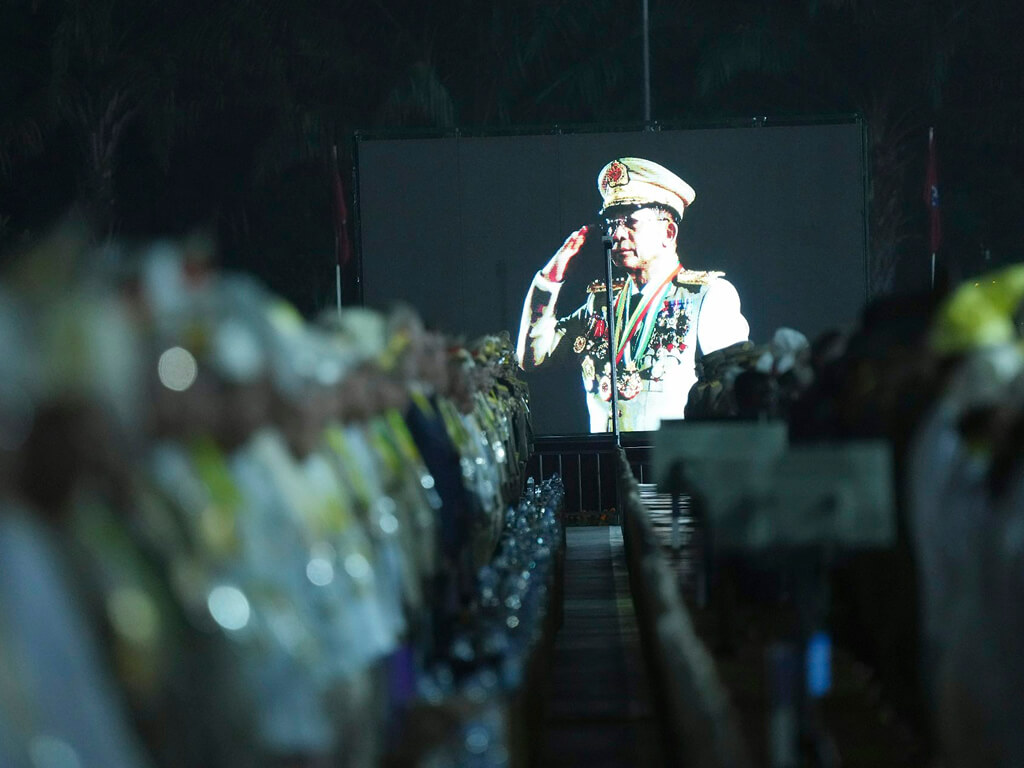
“It’s organized by the military; we can’t let our name be tarnished,” said Min Aung Hlaing, the general who led the coup. “People should vote. If they don’t vote, I will have to say they don’t completely understand what democracy really is.”
China, Myanmar’s largest ally and northern neighbor, has publicly supported the decision to hold elections. Analysts say Beijing views the vote as the country’s best path toward stability. According to military controlled media, China, Russia, India, and Vietnam have sent election observers.
Low Turnout and Early Results
Turnout in Yangon appeared lower than in previous elections. At polling stations, many residents declined to speak with reporters, saying the vote was too sensitive to discuss publicly.
In earlier elections, participation was far higher, with streets awash in red, the color of the National League for Democracy. This time, turnout in the first phase was reported at 52 percent by the junta, compared with roughly 70 percent in the 2015 and 2020 elections.
Preliminary results from the first phase have begun to emerge. Early figures cited by state media show the military backed Union Solidarity and Development Party leading after the opening round of the first general election since the 2021 coup.
Partial results released by the Union Election Commission for 56 constituencies show the junta backed party winning by a wide margin, despite thin turnout. Results published on Friday indicate that the Union Solidarity and Development Party has won 38 of the 40 seats counted so far in the Pyithu Hluttaw, the lower house of parliament.
The Shan Nationalities Democratic Party, also known as the White Tiger Party, and the Mon Unity Party each secured one seat. In regional and state legislatures, the military backed party won 14 of the 15 seats counted under the first past the post system, with the Akha National Development Party taking the remaining seat.
In the upper house, the Amyotha Hluttaw, only one seat has been declared so far, and it was won by the Wa National Party.
No date has been announced for the release of the final election results. While the overall outcome is widely seen as inevitable, attention has shifted to how many seats will ultimately be awarded to the Union Solidarity and Development Party. The second phase of voting is scheduled for January 11, followed by a final round on January 25.