
The new trade pact between Europe and India reflects a relationship built as much on necessity as on ambition. Confronted by the confrontational politics of Donald Trump and Vladimir Putin, Europe finds itself squeezed between rival powers and shrinking room for maneuver. In response, it is turning outward again, seeking partners that can help restore its economic and strategic footing. India has emerged as the most consequential of those choices.
A major economic and political development has now taken shape, with India and the European Union finalizing a landmark free trade agreement, one that European Commission President Ursula von der Leyen described as the “mother of all deals.”
Though the timing is striking, the deal reflects nearly two decades of stop and start negotiations between India and the European Union. First launched in 2007, the talks were repeatedly stalled by disagreements and shifting political priorities on both sides. Over the past six months, that inertia gave way to urgency, with negotiations accelerating and finally concluding late on Monday night, amid the political pressure created by Donald Trump.
Opening India’s Market, Expanding Europe’s Reach
The agreement between Brussels and New Delhi is designed to forge a combined market of two billion people, accounting for nearly a quarter of global gross domestic product, according to the European Commission. It is expected to open India’s vast and traditionally protected market to the European Union’s 27 member states, with a particular focus on manufacturing and the services sector.
The European Union anticipates that the deal could double EU exports to India by 2032. EU estimates suggest that tariffs will be eliminated or reduced on 96.6 percent of traded goods by value, saving European companies approximately €4 billion, or £3.5 billion, in duties. Tariffs will drop to zero on a broad array of industrial products, including nearly all iron and steel, plastics, chemicals, machinery, and pharmaceuticals.
Conversely, the EU will reduce tariffs on 99.5 percent of goods imported from India over a seven-year period..
India is currently contending with tariffs of around 50 percent on its exports to the United States. At the same time, six EU nations faced the threat of higher tariffs over objections to Donald Trump’s attempt to take over Greenland. While the EU market or Indian Market does not match the scale of the United States, officials describe it as a strategically important and compatible alternative trade space.
Cars, Wine, and Agriculture: Key Trade Offs
One of the most significant changes under the agreement affects the automobile sector. Delhi will reduce tariffs on cars to 10 percent over five years, down from rates as high as 110 percent, according to an EU statement. The move is expected to benefit European carmakers including Volkswagen, Renault, Mercedes Benz, and BMW, helping them compete with rivals from the United States, East Asia, and China while boosting revenue and supporting jobs.
Under the pact, up to 250,000 European-made vehicles will ultimately be allowed to enter India at preferential duty rates, far surpassing the 37,000 vehicle limit granted to the United Kingdom under a separate agreement reached last year.
Machinery and electrical equipment valued at sixteen billion euros, representing the largest segment of Europe’s exports to India, will see tariffs reduced from as high as 44 percent to zero. This change is expected to generate substantial savings and make European products more competitive in Indian markets, potentially shifting demand away from China and toward Europe.
Space and aircraft exports worth six billion euros will move from an 11 percent tariff to zero, while optical, medical, and surgical instruments valued at three billion euros, previously subject to tariffs of up to 27.5 percent, will also become tariff-free. Plastics, pearls, precious stones, chemicals, metals, iron, steel, and pharmaceuticals, collectively representing billions of euros in exports, will similarly face zero tariffs under the agreement.
India has also agreed to gradually reduce tariffs on European wines and spirits to between 20 percent and 40 percent, down from the current rate of 150 percent. Duties on olive oil and processed foods such as pasta and chocolate will be eliminated entirely.
At the same time, the EU will maintain tariffs on beef, chicken, sugar, flour, garlic, and ethanol. This concession to European farming interests is widely viewed as essential to securing the agreement’s approval in the European Parliament, which remains particularly sensitive to agricultural concerns.
For India, exports that have been hit hard by U.S. tariff increases will receive significant relief, as Europe opens up its market and reduces tariffs on nearly all Indian goods, with the exception of agricultural products.
Beyond Trade: Security, Mobility, and Research
The free trade agreement was unveiled as part of a broader set of announcements at a summit on Tuesday, reflecting both sides’ efforts to navigate Trump-era tariffs, China’s economic dominance, and the ongoing Russian invasion of Ukraine.
Beyond trade, the EU and India are preparing to sign a security pact aimed at deepening cooperation on maritime security, hybrid threats, and counterterrorism. The EU has described the agreement as a way to “advance alignment” amid longstanding concerns over India’s ties with Russia.
EU foreign policy chief Kaja Kallas noted that the pact also establishes an annual security and defense dialogue, with the first meeting scheduled for later this month. “As the global order shifts, the EU will continue to deepen its diplomatic and economic ties across the world. Strong partnerships multiply our strength,” she said.
The two sides also reached a labor mobility agreement designed to create opportunities for young professionals and seasonal workers. They further committed to launching discussions on bringing India into the EU’s Horizon research program, signaling a move toward deeper collaboration beyond trade alone.
Leaders Hail a Historic Agreement
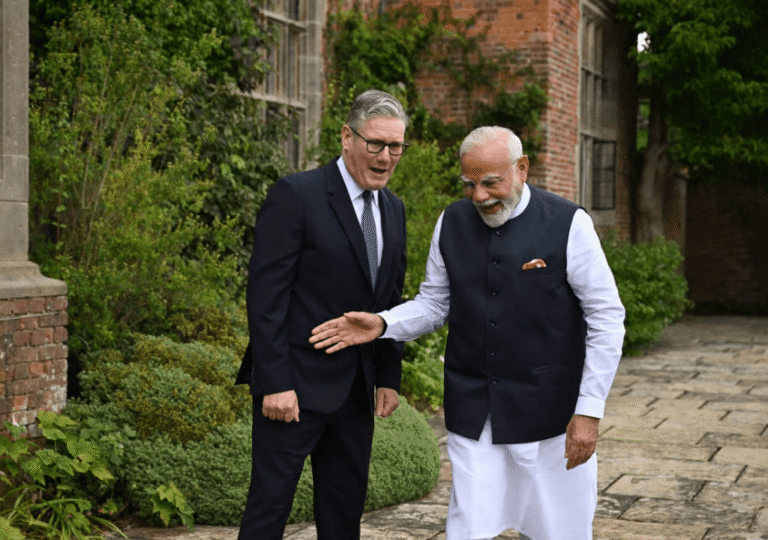
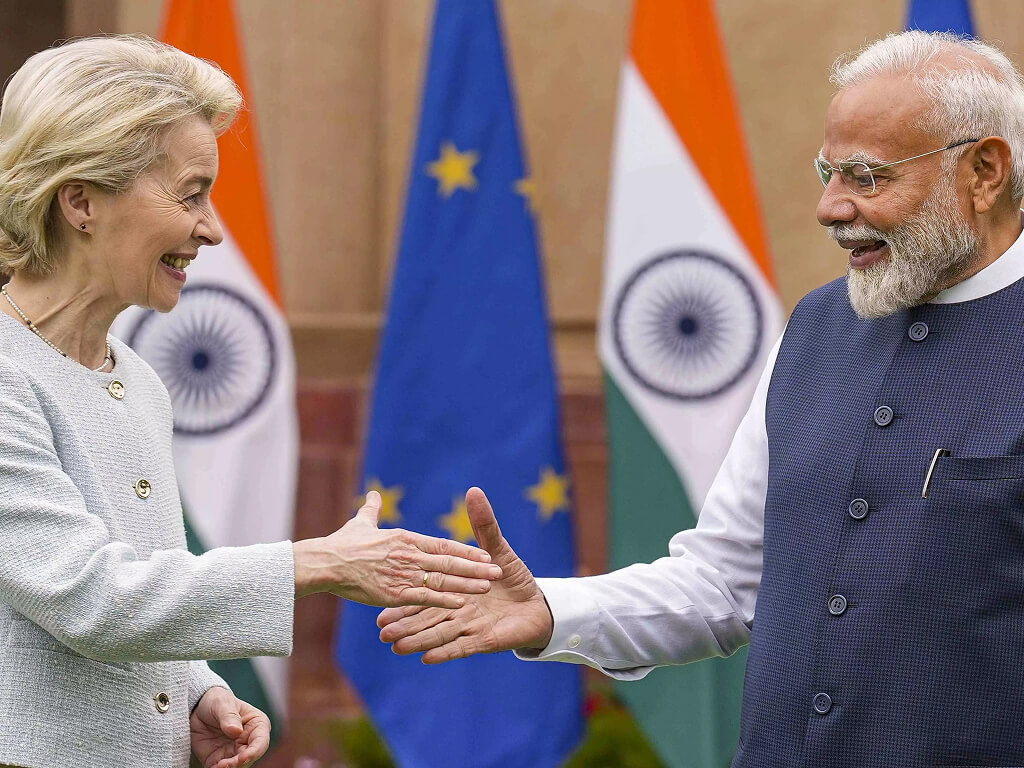
Leaders on both sides praised the agreements openly, acknowledging their value in a turbulent global landscape. “Europe and India are making history today,” von der Leyen said after arriving in New Delhi, where she met Prime Minister Narendra Modi on Tuesday. “We have concluded the mother of all deals. We have created a free trade zone of two billion people, with both sides set to benefit.”
Von der Leyen had previously said she expects EU exports to India to double as a result of the agreement, citing the bloc’s unprecedented access to a market that has long been heavily protected.
Modi echoed her enthusiasm, calling the agreement the “biggest free trade deal in history.” “This agreement has brought massive opportunities for 1.4 billion Indians and millions of people in European countries,” he said. “It has become a wonderful example of synergy between two of the world’s major economies.”
The agreement was met with immediate approval from centrist and center-right lawmakers in the European Parliament. “The EU is serious about cultivating new trading partners, and among the world’s relatively untapped markets, India stands out as one of the most promising,” said Angelika Niebler, a German Christian Democrat MEP who chairs the European Parliament’s delegation for India.
European leaders attended India’s Republic Day parade as chief guests. Notably, von der Leyen chose an Indo-Western achkan for the event, a long buttoned coat with golden brocade. Modi also referenced Portuguese Prime Minister Antonio Costa’s Indian heritage, telling a room of journalists and delegates that Costa is famously known as Lisbon’s Gandhi. Costa’s father’s family originates from Goa, India. Modi suggested that this shared background may have eased negotiations as the two sides worked intensively to bring the agreement to completion. The visit appeared to reflect a genuine mutual desire to strengthen and revive the bilateral relationship.
An Economic Pact With Geopolitical Weight
This time, both the European Union and India appear to have a sharper sense of how the global order is shifting, and both are actively seeking new markets and new partners. As the EU works to diversify its trade relationships, it has recently concluded agreements with South America’s Mercosur bloc, Indonesia, and Switzerland. Within that strategy, India stands out as a particularly consequential partner and a major strategic gain for Europe.
For Europe, which has often operated in the shadow of the United States, closer ties with India represent a notable strategic achievement. Washington has not secured a comparable agreement, despite President Donald Trump’s repeated public expressions of goodwill toward Prime Minister Narendra Modi.
For India, the agreement offers relief at a moment when it has not yet been forced to concede to higher tariffs elsewhere. It also sends a clear signal to Washington that New Delhi can strike substantial deals with other major partners. By deepening its engagement with Europe, India underscores its capacity to negotiate on its own terms within a rapidly changing global trade environment. In doing so, both sides position themselves for a closer and more durable partnership.
The relationship between India and the EU was upgraded to a Strategic Partnership in 2004, marking its twentieth anniversary this year. Cooperation has since widened through the India EU Trade and Technology Council, launched in 2022, with initiatives spanning semiconductors, 6G research, and artificial intelligence.
Security and defense ties have also grown, including joint naval exercises. While parts of Europe’s political left continue to express reservations about India, the two sides now find themselves increasingly reliant on one another. At this juncture, there appears to be no clearer or more practical path forward for either.
Before the agreement can take effect, it must be ratified by EU member states, the European Parliament, and India’s cabinet. European and Indian officials say the formal signing is expected later this year, with the deal potentially entering into force early next year.